What is the meaning of life? Many philosophers have pondered this question. Aristotle believes happiness is life’s purpose and the aim of human existence. Plato believes that the meaning of life can only be achieved by acquiring the highest level of knowledge. However, I think that this question is best answered by a boy and his stuffed tiger.
Calvin and Hobbes is a comic strip written and illustrated by Bill Watterson that follows the imaginative and often other-worldly adventures of a first grade boy, Calvin, and his stuffed tiger, Hobbes. Calvin, who is six years old, is matured way beyond his age in a peculiar way. He thinks outside the box, questioning Einstein’s theory of relativity, human existence, and God. But at the same time, he’s still a six year old, fascinated with dinosaurs and still asks “six-year old” questions about the “grown-up world.” Hobbes is Calvin’s best friend: a stuffed tiger. Hobbes acts as the sink to Calvin’s imaginative faucet, his sidekick who accompanies him through his limitless adventures.
When I was younger (around Calvin’s age, actually), my mom used to read Calvin and Hobbes to my brother and me before bed each night. We had (and still have) these books–collections of Calvin and Hobbes comic strips that my brother and I would get immersed in. We were captivated by the comic’s humor and its creative art style. I remember during school I told my second grade teacher that Calvin and Hobbes was a comic that I enjoyed reading. She was confused by this statement, asking if I really understood it; I was confused by her response. At that time, Calvin and Hobbes was something simple, cute, and funny. Now, reflecting on this memory, it’s quite obvious how ignorant I was of the depth of the comic. Allow me to share with you one of favorite pairs of strips from the comic:
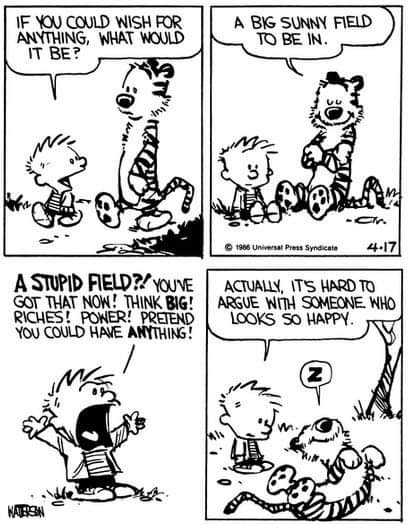
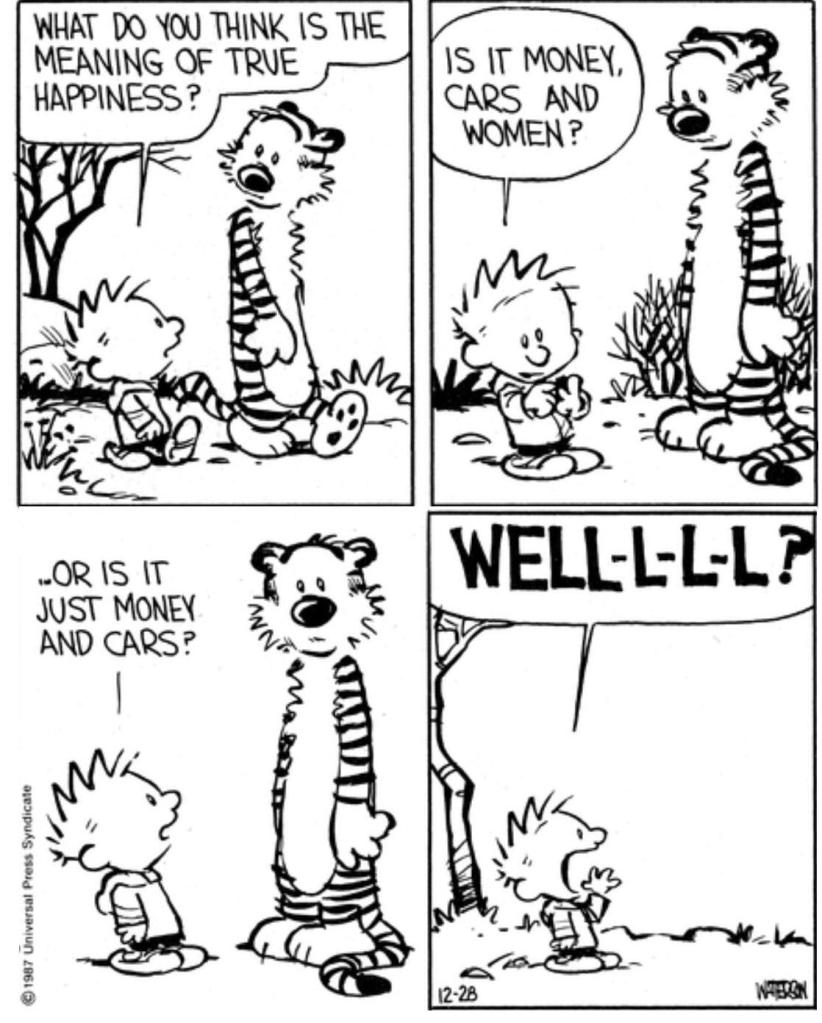
I found the strip on the right funny when I first read it; I thought Calvin’s definition of the meaning of life was not just absurd but also something recognizable, it being a common trope in action movies I had seen where the white, male main character fights some bad guys and then rides away with a chick in a cool car. Now, equipped with my knowledge of bigger words, it’s pretty obvious that this strip brings attention to the idea of materialism and perhaps even highlights Watterson’s satirical remark on the American dream, that everyone is obsessed with owning material items to prove themself of their successes and to achieve “happiness”.
Hobbes’ response to Calvin’s questions in both strips is something that I’ve come to relate with a lot more recently. When I was younger, I always wanted to get lego sets, pokémon cards, or nerf guns for Christmas; I always wanted to have a big, fun birthday party and receive new toys as presents from family and friends; I always wanted to go places like the movies or an arcade whenever my family took me out of the house. Now for Christmas I want clothes and books; for my birthday I don’t really want gifts; for nice sunny mornings, I like to go for walks or runs. I find that this less materialistic outlook on the world is a sign of maturing and, as Hobbes depicts, a truer form of happiness. I give Calvin and Hobbes a 13/13.

 Experiences unfiltered
Leave a comment